
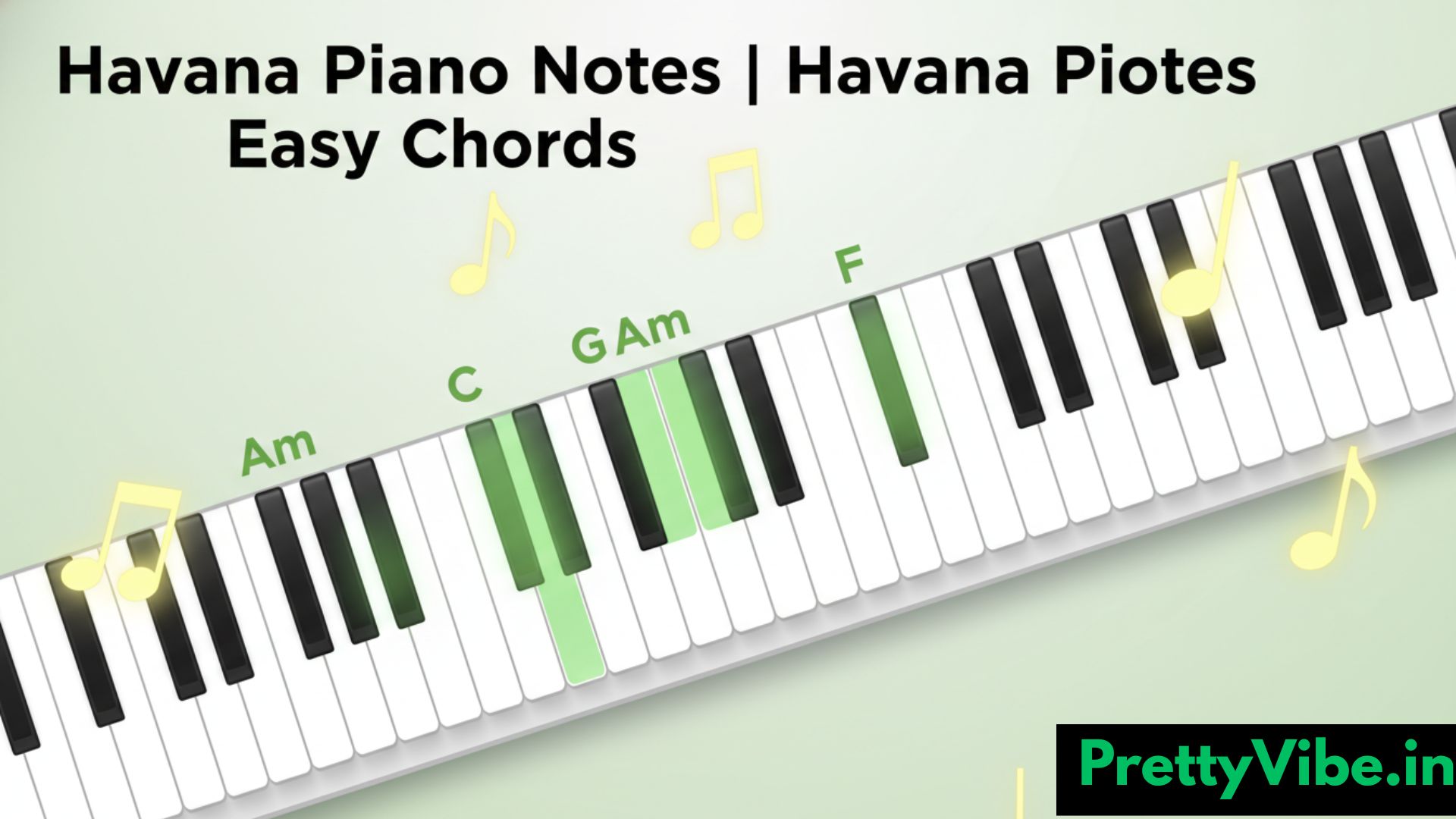
If you’ve been captivated by the intoxicating Latin rhythms of Camila Cabello’s hit song “Havana,” you’re not alone. “Havana” is incredibly popular among piano players because it’s based on a catchy and repetitive groove that sounds impressive but is surprisingly easy for pianists of all levels to learn.
Mastering the Havana Groove
The heart of “Havana” lies in its tumbao rhythm, a classic Cuban bass pattern. On the piano, this means your left hand creates a steady, rhythmic beat while your right hand plays along with the main melody. Since the song repeats the same chord progression throughout, once you’ve mastered the first few lines, you’ve essentially mastered the entire song.
Havana Piano Notes
The melody primarily uses the G Harmonic Minor scale. To capture that “dark” and spicy Spanish flair, you’ll be playing a lot of $Eb$ and $F\#$. The iconic “Havana, ooh-na-na” hook starts on a $G$ and climbs up, relying heavily on syncopation—playing off the beat—to give it that signature swing.
| Element | Notes/Chords |
| Key Signature | G Minor (2 flats: B♭, E♭) |
| Core Chords | Gm, E♭, D7 |
| Main Hook | G – B♭ – D – G |
| Rhythm Style | Syncopated / Tumbao |
Pro tips: Keep your wrists loose! Latin music is all about “the feel.” If you play too stiffly, the song loses its Cuban “sabor” (flavor).
Havana Piano Notes Letters
For beginners who haven’t mastered sheet music yet, playing by letter is a great way to start. The main hook follows this pattern:
- Ha-va-na: G — B♭ — D — G
- Ooh-na-na: G — F — G — B♭
- Half of my heart is in: B♭ — B♭ — B♭ — B♭ — A — G — F
- Ha-va-na: G — F — G
Havana Piano Notes Easy Chords
You only need three chords to play this entire song. This makes it a perfect practice piece for transitions. The progression is:
- G Minor (Gm): G – B♭ – D
- E-flat Major (E♭): E♭ – G – B♭
- D Major (D): D – F# – A
The loop goes: Gm — E♭ — D. You play the G Minor for two beats, the E-flat for one beat, and the D Major for one beat.
Havana Piano Notes Easy
If you are just starting out, try the “Easy Version” by stripping away the complex rhythms. Instead of trying to bounce your left hand, simply hold the root notes (G, E♭, D) as whole notes while you play the melody with your right hand. This allows you to focus on the fingerings for the $F\#$ and $Eb$ without getting tripped up by the beat.